Rockhampton is a city and local government area in Queensland, Australia. The city lies on the
Fitzroy River, approximately 45 kilometres from the river mouth, and some 600 kilometres North of the state capital,
Brisbane.
The European history of the area began in 1853, when the area that would become
Rockhampton was visited by the Archer brothers Charles and William, who were seeking grazing lands. They were acting on information from earlier expeditions by Ludwig Leichhardt and Thomas
Mitchell, who had explored the area in 1844 and 1846 and noted suitable land for grazing then.
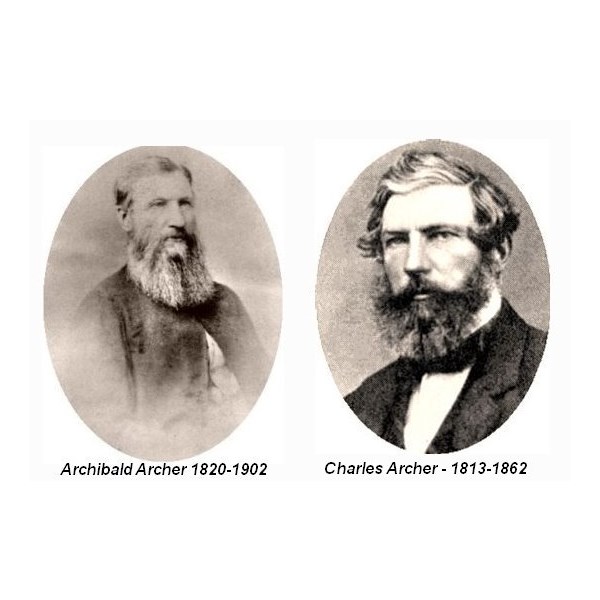
Archibald Archer left - Charles Archer right
In January 1854, the New South Wales Government proclaimed two new districts, Port Curtis and Leichhardt (roughly today's Fitzroy Region), and settlement began in earnest in 1855.
The
Fitzroy River provided a convenient waterway for shipping of supplies for those who followed them, and a settlement grew on the riverbanks just downstream of a bar of rocks which prevented further upstream navigation from the coast. These rocks were incorporated with the traditional English term for a village, and the name "Rockhampton" was first used.
In 1856, the
Elliott brothers arrived at Gracemere and soon after, took up landholdings at Canoona, north of present-day
Yaamba. There, Philip
Elliott and his party came under attack from the Darumbals, possibly of the Taroomball tribe.
Elliott was seriously wounded by a spear and one of his men was killed. However,
Elliott had brought with his party a contingent of native police who turned near-certain loss into victory. It was the first of many battles.
With abundant grazing lands and waters from the
Fitzroy River and its many tributaries and lagoons, the region continued to expand rapidly. In 1858, the town of
Rockhampton was officially proclaimed. The town was surveyed at this time and the first sales of building allotments were held that year. In 1859, gold was discovered at Canoona. Miners rushed to the new field, using the site of
Rockhampton on the
Fitzroy River as the nearest navigable port. The Canoona field proved to be very disappointing and thousands of would-be gold seekers were left stranded at
Rockhampton. Although many returned south, others stayed, adding to the infant town's
population.
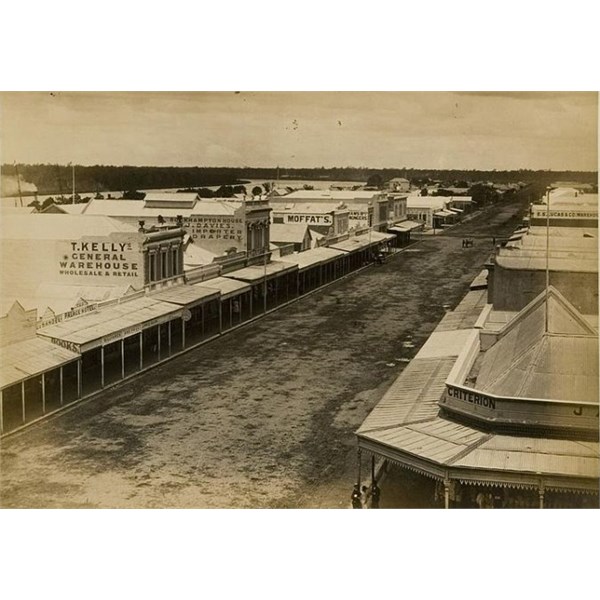
East Street in Rockhampton 1887
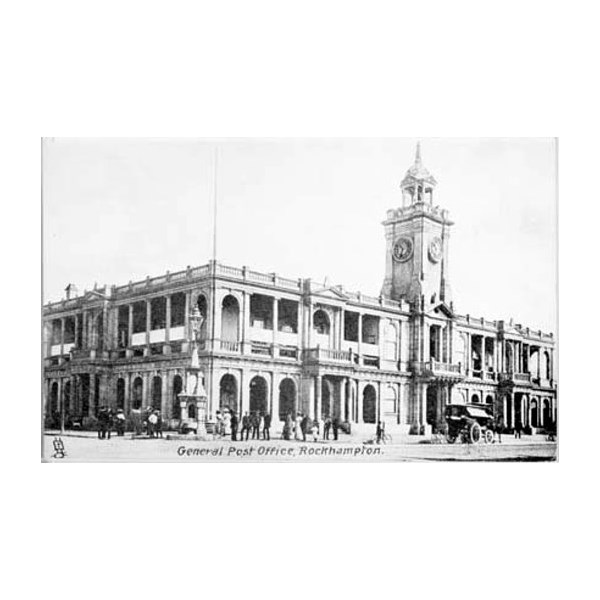
General Post Office, Rockhampton 1901
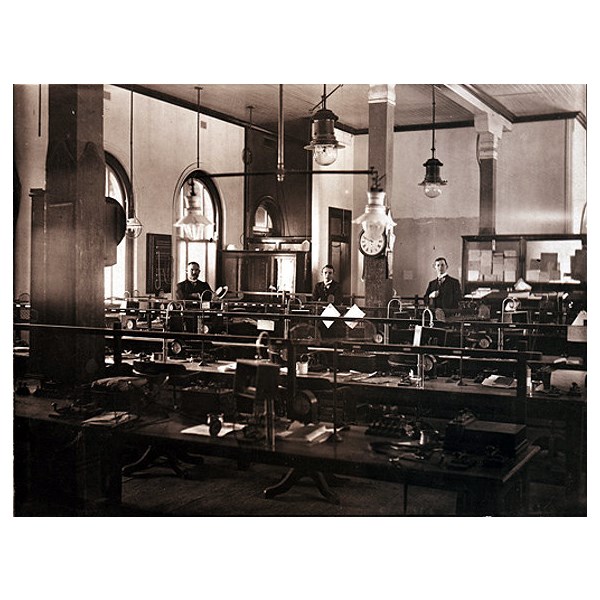
Telegraph staff, Rockhampton, February 1919
Once the town of
Rockhampton was formed, and it had a
population of less than 1000 persons, there was a a very widespread feeling that a School of Arts should be formed, so that the inhabitants should have a cheap and ready means of reading the papers of the other states, and obtaining books and other information so badly needed in a a new community. There was a large attandance of leading townsmen, and it was enthusiasticlly decided that a School of Arts should be established in
Rockhampton. The following gentlemen were appointed a preliminary committee, all of whom were familiar enough to the writer, but alas all dead years ago Messrs. S. Kelly (Rev), John
Jardine, John Palmer, Robert M Hunter, J A Larnach, A F Woods, Frank N Beddek, Andrew Bertram, and C Archer. At a committee meeting, held two days subsequently, Mr William J Brown, P D
Mansfield, William H. Buzacott, and Henry Moore were added to the committee. The committee then decided that the institution should be named the
Rockhampton school of Arst, and that its main object should be the diffusion of literary, scientific, and other usual knowledge amongst its members, to be obtained by means of a reading room, the delivery of lectures, a library, and the establishment of class. The institution thus started with the most approved objects and aspirations, and it will be no exaggeration to say that they have been carried out to the letter, and the
Rockhampton School of Arts stands high among such institutions throughout the length and breadth of this state.
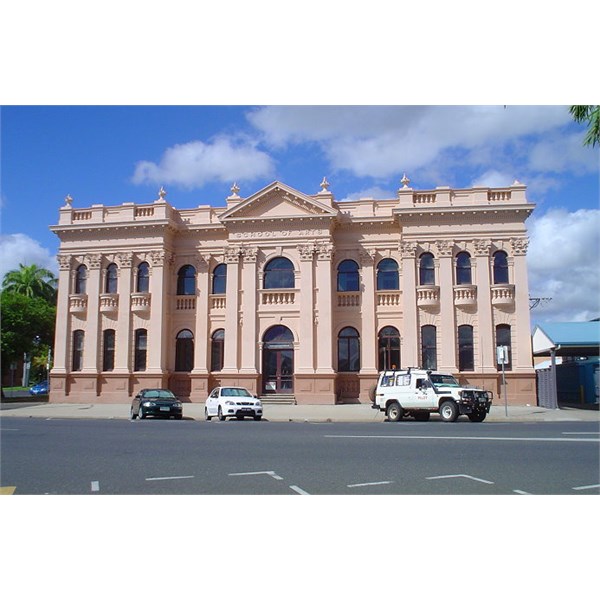
The Rockhampton School of Arts, built in 1894
In 1868 the School of Arts was so
well established, and was making such progress that it was decided to have a payable secretary and librarian. William John Cumming was appointed, and held the position for some years, but he was really to irascible for such a position. and was succeeded by G H Pilcher B. A., who made way for George Potts who resigned in 1889. He was succeeded by N M M Davidson, on whose retirement W. K. Cleeve was appointed and still holds the position, and holds it with credit to himself and satisfaction to subscribers. In fairness it should be added that a modicum of this commandation must be given to his capable and attentive assistant, Miss Gracie Perrier.
In the 1880s and 1890s, sea ports were established on the coast, adjacent to the mouth of the
Fitzroy River. Broadmount was on the northern side and Port Alma on the south. Railways were subsequently constructed to carry goods to the wharves at these locations, the railway to Broadmount opening on 1st January 1898 and the line to Port Alma opened on 16 October 1911. Maintenance on the Broadmount line ceased in August 1929. The following month,
the wharf caught fire and the line was effectively closed in July 1930. The line to Port Alma closed on 15 October 1986.
The significant gold deposit at
Mount Morgan to the southwest was discovered in the 1880s, and
Rockhampton became the main port through which the wealth of
Mount Morgan gold was channelled. Due to the wealth of
Mount Morgan,
Rockhampton weathered the severe economic depression of the 1890s and many of the town's substantial brick and stone public buildings date from this period. The historic streetscape of Quay Street still displays a number of substantial historic buildings, built when
Rockhampton was envisaged as being capital of a state of North Queensland. Most prominent of these is the
sandstone Customs House (1900), which today houses an
information centre. Other important nineteenth century buildings include the
Post Office (1892), the Supreme Court House (1888), and
St Joseph's Cathedral (1892).
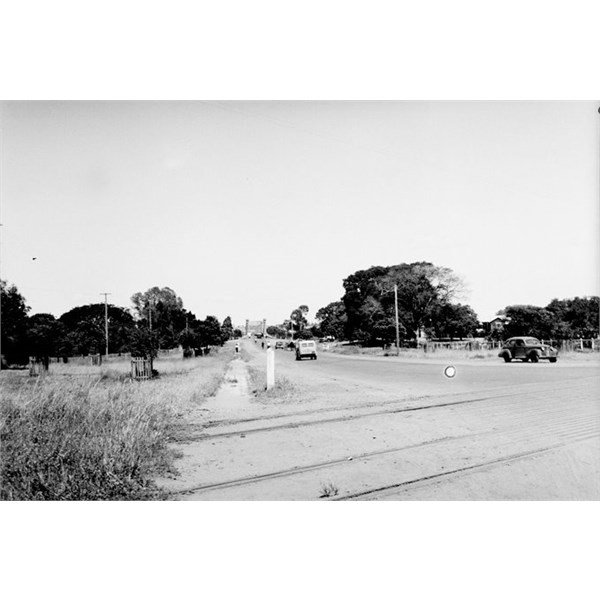
Approach to north end Fitzroy Bridge 1945
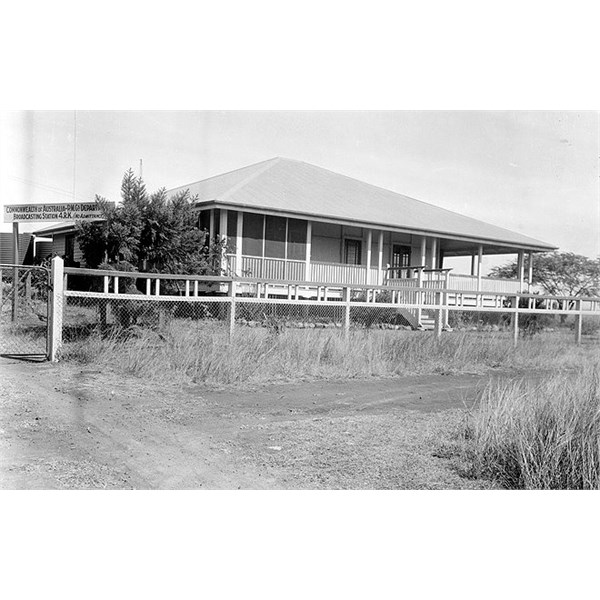
Radio station 4RK, Rockhampton 1950
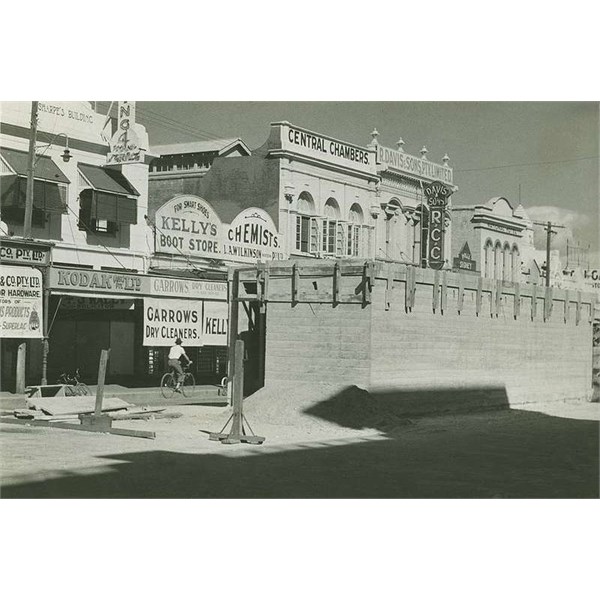
Newly constructed air raid shelter on East Street, Rockhampton, ca. 1942
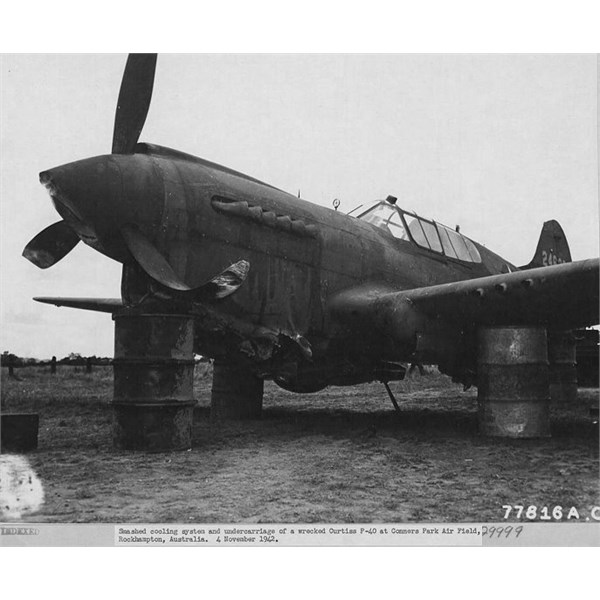
Smashed cooling system and landing gear on a wrecked Curtiss P-40 Kittyhawk at Conners Park Airfield, Rockhampton 1942.
The City of
Rockhampton was proclaimed in 1902. The rail connection south to
Brisbane was completed in 1903, but it was not until 1921 that the northern connection to Mackay was finally completed. A railway west from
Rockhampton was started in 1867 and by 1892 had reached the terminus at
Longreach, 700 kilometres away. This further strengthened
Rockhampton's role as the port for the whole of Central Queensland.
A passenger tramway began operating on 16 June 1909, making
Rockhampton the only provincial city in Queensland to have a street tramway. Purrey steam trams ran on a number of
routes throughout South
Rockhampton, totalling 10 kilometres of track. The discomfort of passengers riding in steam trams in a tropical climate in part led to their demise in 1939, replaced by a bus network run by the City Council.
During the Second World War, a US army base was established outside the city; it hosted up to 70,000 servicemen en route to action in the Pacific and New Guinea.
The
Fitzroy River Barrage was commissioned in 1971. The barrage has a capacity of 81,300 megalitres and holds back a lake 60 kilometres long. The barrage was funded by the City Council to provide a reliable source of
water to the city, and to effectively drought proof
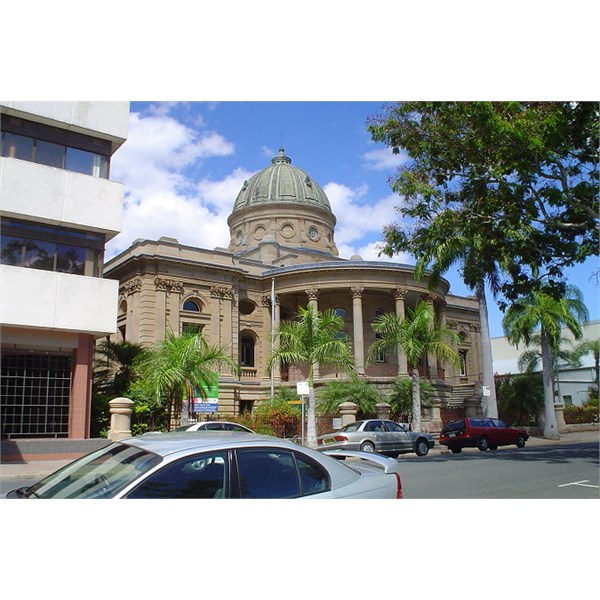
Rockhampton Custom House, Rockhampton, Qld, Est 1898-1901
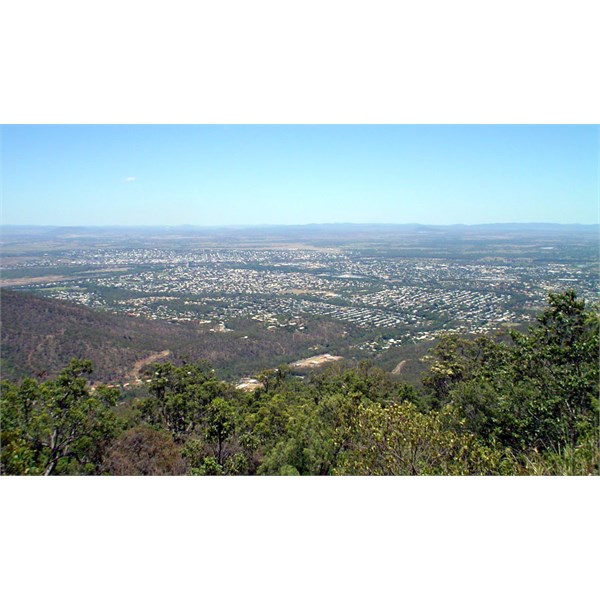
Rockhampton from Mt Archer, March 2006
.