Electrical setup sanity check
Submitted: Monday, Dec 12, 2022 at 09:52
ThreadID:
145115
Views:
5246
Replies:
6
FollowUps:
17
This Thread has been Archived
Damian D
Hi all, making a few changes to my electrical setup in my dual cab. It's always been a bit half assed with a standard battery box (charge at home) and fridge. I was hoping someone with a little experience might be able to advise if the diagram below checks out. It has most of the info but a couple more points
- I am happy using the build in DC/DC charger in the engel battery box. I know this is going to be slower than using the alternator directly but I dont want to go down the track of integrating too much with the cars existing system. I think this setup keeps it all self contained.
- Any problems with running the solar and fridge off an anderson splitter? I have done a few tests, the solar puts about 130W in, the fridge draws about 40Max. So (pending weather conditions etc), sunny day with the fridge working hard should be +90W going in. Any problems with this?
- If I did run the car with the panels plugged in (input from both DC/DC charger and from panels) would this be a problem? (unlikely as panels are only for when we pull up)
- Isolator is switchable. My thinking was that if the crank battery went flat I could plug the solar in there, switch the isolator and it would charge crank battery.
- Any other thoughts or suggestions on this set up?
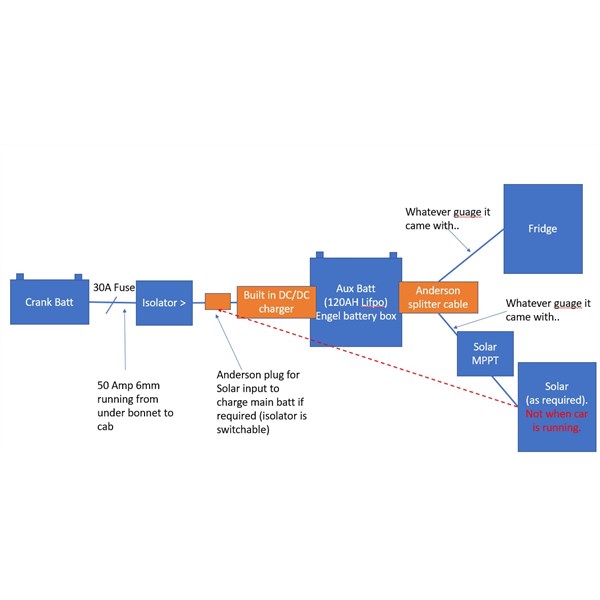
Dual battery and accessories
Reply By: Peter_n_Margaret - Monday, Dec 12, 2022 at 10:10
Monday, Dec 12, 2022 at 10:10
" - If I did run the car with the panels plugged in (input from both DC/DC charger and from panels) would this be a problem?"
No problem at all.
Cheers,
Peter
OKA196 motorhome
AnswerID:
642286
Reply By: Member BarryG - Monday, Dec 12, 2022 at 10:27
Monday, Dec 12, 2022 at 10:27
To my understanding, the dotted red line is wrong. I understand the intention, but an unregulated panel should not be connected directly to a battery. It should go via the MPPT regulator.
(I may be wrong here!)
AnswerID:
642287
Follow Up By: Frank P (NSW) - Monday, Dec 12, 2022 at 10:52
Monday, Dec 12, 2022 at 10:52
I agree with BarryG - the DC-DC is not designed to take unregulated solar input (unless, of course, it has a solar input terminal). The rest of it looks ok.
Damian, if you want solar backup for your crank battery a simple way would be to have an Anderson hanging off the crank battery, unused most of the time. Should the cranker go flat, just plug the solar regulator's Anderson into the cranker's Anderson.
EDIT: If you can make the isolator work with a flat cranker, then yes, you could unplug the Anderson between the isolator and the DC-DC and plug in the regulated output from the solar. To make your diagram correct the dotted red line should come from the output side of the solar regulator, not from the panel.
FollowupID:
921788
Follow Up By: Damian D - Monday, Dec 12, 2022 at 11:02
Monday, Dec 12, 2022 at 11:02
Ah good point, that was the intention, I just put the line in the wrong place :)
I'll also add that if I were to do that, the rest would be disconnected. One anderson plug coming out of the isolator. Would unplug from the DC/DC charger and plug in the panels. I think this addresses Frank P's helpful point also.
Updated:
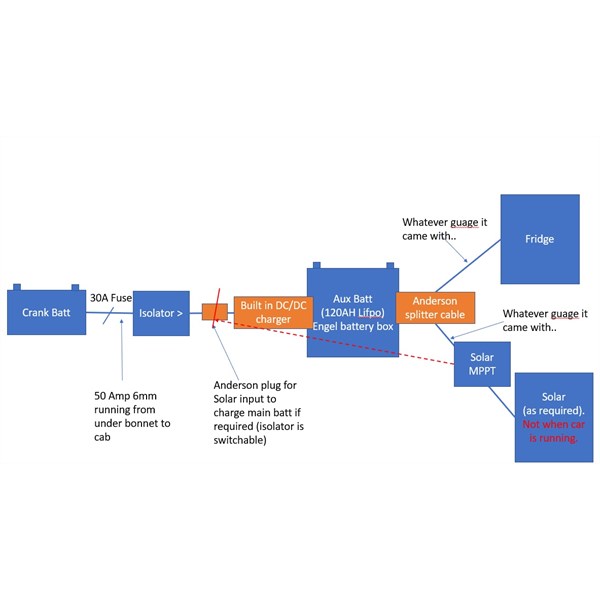
Dual batt and accessories updated
FollowupID:
921789
Follow Up By: Frank P (NSW) - Monday, Dec 12, 2022 at 11:05
Monday, Dec 12, 2022 at 11:05
You posted your amended diagram as I was editing. I think You, Barry and I are on the same page. All good.
FollowupID:
921790
Follow Up By: Damian D - Monday, Dec 12, 2022 at 11:17
Monday, Dec 12, 2022 at 11:17
Thanks legends!
Yeah, the option to charge the crank battery since the port is there anyway is nice but I don't plan on having to use it very often if at all. Keeping it to a single plug means effort to switch it over so I don't accidentally leave the isolator switched or something like that after a few beers ;)
Thanks again!
FollowupID:
921791
Reply By: Batt's - Monday, Dec 12, 2022 at 11:21
Monday, Dec 12, 2022 at 11:21
Redarc sell a battery isolator that monitors the starter battery and if the voltage drops to a set level it switches over and lets the solar top the battery up so you don't have to monitor it yourself. I set one up yrs ago when the aux battery was connected to the starter battery via the Redarc isolator and solar was attached to the aux battery via it's own solar regulator. Simple setup that works
well.
AnswerID:
642288
Reply By: Member - Bigfish - Monday, Dec 12, 2022 at 16:35
Monday, Dec 12, 2022 at 16:35
Dont forget you will also have to alter the output when using the MPPT solar regulator to lithium for aux battery and lead acid for start battery.
I just mounted 2 MPPT solar regs in the car and switch the solar panel cable to appropriate anderson plug for either the start or aux lithium battery.
AnswerID:
642290
Follow Up By: Damian D - Monday, Dec 12, 2022 at 16:59
Monday, Dec 12, 2022 at 16:59
This is new to me. Are MPPT's usually programmable to do this? I bought the kings 200W solar blanket with MPPT. It doesnt mention the battery type/s it's compatible with.
FollowupID:
921792
Follow Up By: Member - Bigfish - Monday, Dec 12, 2022 at 17:31
Monday, Dec 12, 2022 at 17:31
Good MPPT's are certainly programmable. My 2 Victrons as
well as another MPPT I have are all programmable for selecting the right charging profile for different types of batteries. Same as 240 volt to 12 volt chargers are all programmable (dc/dc as
well)..
FollowupID:
921793
Follow Up By: Peter_n_Margaret - Monday, Dec 12, 2022 at 19:55
Monday, Dec 12, 2022 at 19:55
My 18 year old PWM Plasmatrnics solar controller is programmable.
I would not buy anything else. Even lead acids are not all the same and complying EXACTLY with the manufacturer's charging recommendations can only benefit.
Cheers,
Peter
OKA196 motorhome.
FollowupID:
921794
Follow Up By: Member - Bigfish - Monday, Dec 12, 2022 at 20:11
Monday, Dec 12, 2022 at 20:11
So true Peter-n-Margaret. Always follow what the battery manufacture states...not a generalisation!! This will give you the best from your battery.
FollowupID:
921795
Follow Up By: Damian D - Tuesday, Dec 13, 2022 at 07:48
Tuesday, Dec 13, 2022 at 07:48
This was all great advice thankyou. Turns out the controller I got with the solar blanket is not compatible with the LIFOPO4 battery. Should have done my homework before I jumped on that bargain...
I have tested it and it works but I dont want to do any damage to the battery and want to make sure I get the most out of it. Oh
well, more $'s to spend now I guess :(
Thanks again.
FollowupID:
921797
Follow Up By: Member - Bigfish - Tuesday, Dec 13, 2022 at 07:51
Tuesday, Dec 13, 2022 at 07:51
I,d get a Victron 20amp model with bluetooth. If you get a bigger or more panels it is still up to the job and bluetooth is very handy for seeing history and real time performance of the regulator.
FollowupID:
921799
Follow Up By: Damian D - Tuesday, Dec 13, 2022 at 08:41
Tuesday, Dec 13, 2022 at 08:41
Thanks mate, will check it out. I'm a sucker for technology so bluetooth sounds great :)
Will using the non lithium one (kings 20A cheapy that came with the blanket) actually damage the battery or just not work optimally do you reckon? Just wondering if I need the new one before heading off for a
camp this weekend :)
EDIT: After a bit of a google it seems that it will work and shouldnt damage the battery since the battery has in built BMS. But it will charge slower and not make it to the full 100%
FollowupID:
921800
Follow Up By: Member - Bigfish - Tuesday, Dec 13, 2022 at 08:51
Tuesday, Dec 13, 2022 at 08:51
If you can afford to get one for the weekend that would be best practice. However if your only using the fridge for cooling and your not in too warm an environment the battery may last all weekend. Use the current regulator if you have to but I,d disconnect once lithium got to say 80%. . Reg has not got the correct settings for maintaining and charging a lithium . Get the lithium below 50% and then use the reg. It wont hurt.
Get the lithium reg asap.
FollowupID:
921801
Follow Up By: Damian D - Friday, Dec 16, 2022 at 15:04
Friday, Dec 16, 2022 at 15:04
Picked up the Victron 75/15 which is good for 12v 200W. Might regret it in the future but I've already spent a small fortune on this set up! 200W will work fine for our use.
Thanks for the recommendation, it's a great bit of kit for the job.
FollowupID:
921834
Follow Up By: qldcamper - Monday, Dec 19, 2022 at 07:43
Monday, Dec 19, 2022 at 07:43
Why do people always spend the money then ask advice after? Just human nature i guess.
FollowupID:
921858
Follow Up By: Damian D - Monday, Dec 19, 2022 at 21:27
Monday, Dec 19, 2022 at 21:27
haha, yeah I guess so. I had a pretty good idea about the set up but was glad I ran it past this
forum for my "sanity check" and peace of mind.
The one mistake I made was assuming that my solar blanket and MPPT would be fine for lithium battery. The one I got popped up cheap on a black Friday sale so I nabbed it without research.
Worked out alright though, still worked out cheaper even having to buy the new MPPT.
FollowupID:
921875
Follow Up By: qldcamper - Tuesday, Dec 20, 2022 at 07:17
Tuesday, Dec 20, 2022 at 07:17
You wont regret investing in the victron, they are bullet proof, been using one for several years.
It gives you the flexability to experiment with series connection.
In a stand alone system on a ute 200 watts will be as big as practical, any more just gets too big to be managable and you will rarely need more if ever.
Its when you start towing you will probably need more, then just put a second system on the trailer.
FollowupID:
921877
Reply By: Damian D - Monday, Dec 12, 2022 at 16:55
Monday, Dec 12, 2022 at 16:55
Final update for anyone stumbling across this (I hate when I find a partial thread). The setup in the above threads has worked a treat, thanks for the help guys. Summary..
See threads for actual solution, initial diagram is not right.
Triton MR Dual Cab.
50amp wiring from crank battery under the hood with 30amp fuse right up close to the battery. Ran it through the chassis frame mostly, was careful to make sure it wasn't gonna rub too much anywhere.
Brought it up into the cab where the taillight loom went in. Was about 5 meters, was no voltage drop that my multimeter detected.
Straight into a "Ridge Ryder 140A" isolator. Then out the other side into a single anderson plug. This isolator will let your aux battery charge when the voltage is high enough (car is running), and not let it drain your main battery to start the car. Then into..
Engel battery box series 2 via DC/DC charger, same as plugging it into ciggie plug. This is a great piece of gear and you can get the mount so you can slide it out and carry it to
camp if you cant
park close (side note, 120AH lifepo is almost exactly 1/2 the weight as an AGM battery of same capacity). Has 240v 300w inverter, USB. BUT, and this is annoying.. It wont charge unless you have the screen turned on. So you have to leave it "on" for the car to charge it but leaving it on means the screen draws a bit of power. It's fine mostly, but if your car sits there a few weeks then your aux battery is gonna discharge for no good reason.
DC/DC charge on the Engel box is fine for me but it's not quick. It puts about 60W in, this means a lot of driving to charge a half full battery (like 9 hours). 200W solar blanket puts about 130W in. My draw is just fridge (40w max) and some lights at night and a few bits and pieces like torches and things. So I reckon it will do just fine unless there is no sun for days.
Also, when mounting stuff into tray, dont be an idiot like me and make sure you drill the right size hole so you dont snap your SS screws off.
AnswerID:
642291
Follow Up By: Frank P (NSW) - Monday, Dec 12, 2022 at 22:01
Monday, Dec 12, 2022 at 22:01
"Was about 5 meters, was no voltage drop that my multimeter detected."
Damian,
Was that under a load? If you don't have a load there will be no voltage drop and that doesn't prove anything. BUT if your DC to DC is working then any voltage that is occurring seems to be acceptable.
You could measure it by running the vehicle to get the system working. (Best with a partially discharged Engel battery so that there's a decent load on the DC-DC). Then
- test the voltage at the crank battery;
- back probe the Anderson that supplies the DC-DC and measure that voltage.
- the difference is the voltage drop.
FollowupID:
921796