Do you grease your nuts
Submitted: Sunday, Mar 15, 2026 at 12:00
ThreadID:
152286
Views:
2545
Replies:
10
FollowUps:
34
This Thread has been Archived
Member - nick boab
Good morning all. I'v been in maintenance mode in the last week & getting the caravan ready for
Easter providing we can still afford to travel then.
Have a 2020 Jayco journey Outback . amongst other things I have been upgrading the drainage out of the shower which was pretty poor for getting
water drained out of the shower , we would be standing in
water during a shower :( Upgraded it to more conventional 40 mm PVC drainage .
Checking over the wheel bearings this morning I noticed that the wheel nuts were
well greased to a point of wet..
I know we don't like to have them dry and grabbing locking up , but how much is too much? I was wondering what others do, maybe a little dab of copper Grease.
Love to hear what others opinions are and any other maintenance hacks you may carry out before a trip away.
Reply By: Member - Jim S1 - Sunday, Mar 15, 2026 at 12:12
Sunday, Mar 15, 2026 at 12:12
Not sure about greasing wheel nuts ........ I don't .
Wheel nuts should not be greased. Manufacturers specify that stud threads and mating surfaces be clean and dry to ensure accurate torque readings. Lubricating threads reduces friction, causing over-tightening (stretching studs) at standard torque settings, which can lead to stud breakage or
wheels coming loose.
Something else to think about .
Cheers
Jim
AnswerID:
649030
Follow Up By: Member - nick boab - Sunday, Mar 15, 2026 at 12:51
Sunday, Mar 15, 2026 at 12:51
Thanks Jim I did think it was excessive and have wiped of what I can .
well nuts certainly weren't tight I think a child could have undone them without any problems .
I'll give them a clean off .
FollowupID:
930685
Follow Up By: Member - LeighW - Sunday, Mar 15, 2026 at 13:34
Sunday, Mar 15, 2026 at 13:34
This has been discussed on other forums, apparently there are some vehicles around
that the manufactures do specify that the wheel nut threads be greased. So always
best to check what the manufacturer specifies.
FollowupID:
930686
Follow Up By: Peter_n_Margaret - Sunday, Mar 15, 2026 at 14:09
Sunday, Mar 15, 2026 at 14:09
OKA wheel nuts (8 @ 5/8" UNF @ 6.5" PCD) are specified to be "lightly greased" and the torque settings are relatively low as a result.
This is quite unusual. The general rule is "clean and dry".
Cheers,
Peter
OKA196 motorhome
FollowupID:
930687
Follow Up By: RobMac (QLD_Member) - Monday, Mar 16, 2026 at 16:57
Monday, Mar 16, 2026 at 16:57
I've been greasing the threads on the wheel nuts of my cars for the past 40yrs w/o any issues. Personally, I think not lubricating the thread on the wheel nuts can cause more issues than not lubricating. Obviously u ony use a small amount of grease.
FollowupID:
930698
Follow Up By: Peter_n_Margaret - Wednesday, Mar 18, 2026 at 12:45
Wednesday, Mar 18, 2026 at 12:45
My attitude is to follow the manufacturer's instructions.
I figure they probably know best, or at least more than me.
Cheers,
Peter
OKA196 motorhome
FollowupID:
930711
Follow Up By: Allan B (Sunshine Coast) - Wednesday, Mar 18, 2026 at 13:09
Wednesday, Mar 18, 2026 at 13:09
.
Ah Peter, you are so trusting. The manufacturers likely want you to wear/break things so they can sell you overpriced replacements.
FollowupID:
930712
Follow Up By: North 200 - Thursday, Mar 19, 2026 at 16:10
Thursday, Mar 19, 2026 at 16:10
Peter, experience has taught me engineers work in workshops and are usually correct, but they don’t get down and get dirty in real world conditions.
FollowupID:
930725
Follow Up By: Allan B (Sunshine Coast) - Thursday, Mar 19, 2026 at 18:23
Thursday, Mar 19, 2026 at 18:23
.
North, most workshop that I have seen are very much in "real world conditions".
Would you care to expand your proposition?
FollowupID:
930727
Reply By: Stephen L (Clare) SA - Sunday, Mar 15, 2026 at 14:06
Sunday, Mar 15, 2026 at 14:06
Hi Nick
I apply Never Seize, small dab on my finger and small amount to the wheel studs, then use my torque bar to the correct tension, never any problems betting them off and the smear on the studs stops any rusting.
AnswerID:
649032
Follow Up By: Peter_n_Margaret - Sunday, Mar 15, 2026 at 14:11
Sunday, Mar 15, 2026 at 14:11
My understanding is that "Never Seize" is a serious NO-NO. Worse than grease.
Cheers,
Peter
OKA196 motorhome
FollowupID:
930688
Follow Up By: Stephen L (Clare) SA - Sunday, Mar 15, 2026 at 16:17
Sunday, Mar 15, 2026 at 16:17
Any reason why Peter?
FollowupID:
930690
Follow Up By: Stephen L (Clare) SA - Sunday, Mar 15, 2026 at 16:32
Sunday, Mar 15, 2026 at 16:32
Wow Peter, just looked at a YouTube video , looks like better off using nothing, was nor aware of the consequences, thank you for the heads up.
Cheers
FollowupID:
930691
Follow Up By: Stephen L (Clare) SA - Sunday, Mar 15, 2026 at 17:06
Sunday, Mar 15, 2026 at 17:06
Now it gets really challenging, more google and YouTube, many suggest, yes use anti seize….but reduce the torque value by around 20%.
Is this now opening up a real can of worms ?
FollowupID:
930693
Follow Up By: Allan B (Sunshine Coast) - Thursday, Mar 19, 2026 at 18:17
Thursday, Mar 19, 2026 at 18:17
.
Hi Stephen, 20% torque reduction seems to be conveniently proposed, but by which organisation or engineer? I think that 20% was just pulled out of the air and would like to see the justification for that value. I lubed and continued to use the OEM torque specification.
I considered that my maintenance and lubing maintained the original new surfaces and that by lubing I maintained that condition and hence torque requirements.
Back in the 1900's virtually no-one used a torque wrench on the wheel nuts. You simply tightened them as tight as you could using the tool provided. Seemed to work OK then. Many still do.
FollowupID:
930726
Follow Up By: Member - Gordon B5 - Friday, Mar 20, 2026 at 00:10
Friday, Mar 20, 2026 at 00:10
I still use a wheel brace, 73 & been using one since I was 16. Never had a problem. Youngest son is Diesel & Auto electrician in the mines over here & gave me anti-seize years ago when he was giving me a hand to do brake pads. Have used it ever since without any trouble. The blokes in those
mine workshops have very low options of engineers that design the stuff they work on by the way. What sort of Mechanic is he ?
Well he’s been working on a
mine site that is going back into production after a hiatus of some years, on his own so they must think he’s good enough or they wouldn’t have sent him there I recon. We’re proud of the boy.
FollowupID:
930728
Reply By: Member - nick boab - Sunday, Mar 15, 2026 at 15:29
Sunday, Mar 15, 2026 at 15:29
Before I wiped the excess grease off
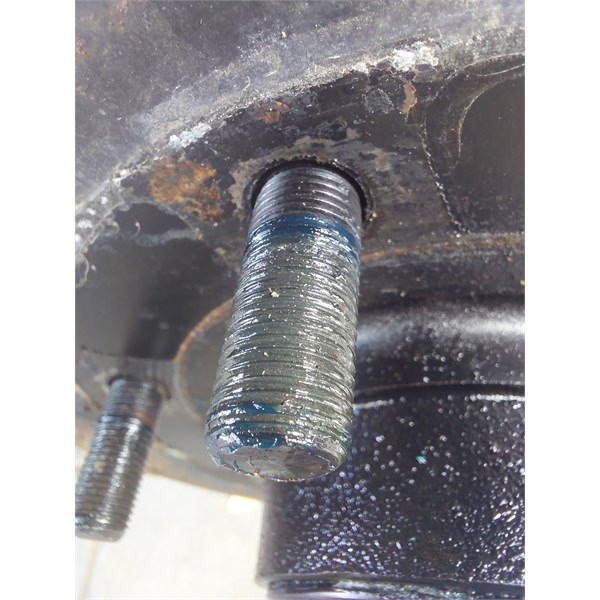
Wheel stud
AnswerID:
649033
Follow Up By: Stephen L (Clare) SA - Sunday, Mar 15, 2026 at 16:35
Sunday, Mar 15, 2026 at 16:35
After watching a YouTube video, looks like I have been wrong and we all should just be using nothing, there is far more into it.
Cheers
Stephen
FollowupID:
930692
Follow Up By: Stephen L (Clare) SA - Sunday, Mar 15, 2026 at 17:25
Sunday, Mar 15, 2026 at 17:25
Hi again Nick
Lots more watching and googling, yes they say use Never Seize or lubricant…..now for the can of worms, reduce the factory torque recommended setting by 20% to stop over stretching.
I am no expert, they the videos I watched all recommended this method and the reduction of the factory torque setting ?
Wonder what others now have to say ?
FollowupID:
930694
Follow Up By: Peter_n_Margaret - Sunday, Mar 15, 2026 at 17:28
Sunday, Mar 15, 2026 at 17:28
I suspect that Never-Seez is very good at the job it is designed for and that makes it MUCH harder to completely remove compared to grease too?
Cheers,
Peter
OKA196 motorhome
FollowupID:
930695
Follow Up By: Member - nick boab - Sunday, Mar 15, 2026 at 17:28
Sunday, Mar 15, 2026 at 17:28
Stephen, I think the lesson here is to be aware and learn new modern techniques.
I was told maney years ago by a diesel mechanic to use a little copper Grease
FollowupID:
930696
Follow Up By: North 200 - Monday, Mar 16, 2026 at 09:38
Monday, Mar 16, 2026 at 09:38
In the black coal underground industry a little bit of lube is always used on wheel studs.
FollowupID:
930697
Reply By: Allan B (Sunshine Coast) - Sunday, Mar 15, 2026 at 19:56
Sunday, Mar 15, 2026 at 19:56
.
I used an anti-seize thread lubricant on the Troopy. Only lightly applied to the treads and not to the coned face of the nuts.
In the industries I worked in it was common to lubricate the threads of critical fastenings. I observed it but was not directly involved. I appreciated that the construction engineers acted upon established standards for these specific applications. For automotive application there seems to be no universal standard or advice. I can only observe that no new car of
mine ever appeared to have lubricant on the wheel studs.
But consider the physics involved…. when tightening and using a torque wrench, the wrench is actually measuring or reacting to the torsional force, although this torsional force is a function of both the friction on the threads and on the face of
the nut plus the clamping force or bolt stretch. The friction of the threads and nut face are somewhat variable due to the surface condition which will change from new and clean to dirty and somewhat corroded with time. Hence it is not a particularly accurate method of clamping to a particular force but is convenient. Lubricating the threads eliminates one variable but without expert engineering advice I was reluctant to lubricate
the nut face. I still tightened
the nut to the manufacturers specified torque value as I was unsure of the effect of the change and anyway still had the friction of
the nut face in the equation. I felt that I had a more reliable clamping effect than with dry bolts. I never had any problem with nuts loosening.
In industry, the practice for some critical applications such as the flange bolts of high pressure natural gas pipelines, was to lubricate both the threads and
the nut face and tighten
the nut by hand wrench until positively tight.
The nut was then rotated by a further specified number of rotation degrees usually by means of a slogging spanner and sledge hammer. This specified rotation combined with the thread pitch stretched the bolt by a known amount and produced the desired clamp force reliably. But no, I am not suggesting you do that to your
wheels.
AnswerID:
649036
Reply By: RMD - Monday, Mar 16, 2026 at 11:50
Monday, Mar 16, 2026 at 11:50
Nick.
I am amused as to how people take notice of YOUTUBE instructions, Grease/No GREASE. I particularly like the beginners guide to BRAIN SURGERY for the latest up to date methods. I do have a BATTERY DRILL and HOLE SAW.
I wonder IF anyone has actually tightened wheel nuts sufficiently, or perhaps torqued it.,- Marked the positions etc., and then added some lube to the SAME nut/STUD with the SAME TORQUE and see just how much more the FLATS of
the NUT readily turns past the original position. I usually add a little lube spray to limit GALLING of nut and STUD thread. Just reducing torque by 20% because YT said so, is a bit SUS. The only real way is to measure the STUD stretch with lube and without at same torque. I used to rebuild CAT engines and often they used known length bolts and tightened to a specific STRETCH LENGTH increase which indicates CORRECT CLAMPING FORCE. NO TORQUE WRENCH used!
AnswerID:
649038
Reply By: Geoff (Newcastle, NSW) - Wednesday, Mar 18, 2026 at 10:01
Wednesday, Mar 18, 2026 at 10:01
I've always put anti seize on wheel nuts and studs.
Never had one work loose, break or come off.
It's a religion on my boat trailer as these threads are a magnet for salt
water and corrosion. The number of people I have seen shear off studs trying to change a flat tyre on a boat trailer is scary!
| Geoff,
Grey hair is hereditary, you get it from children. Baldness is caused by watching the Wallabies.
Lifetime Member
My Profile My Blog Send Message |
AnswerID:
649048
Follow Up By: Member - nick boab - Wednesday, Mar 18, 2026 at 10:34
Wednesday, Mar 18, 2026 at 10:34
Geoff, another good practice is to use Lanox mx4 on moving parts Threads and bits and pieces on the boat & trailer aswel I use a battery- terminal sealant on the wiring components.
FollowupID:
930709
Follow Up By: Geoff (Newcastle, NSW) - Wednesday, Mar 18, 2026 at 12:17
Wednesday, Mar 18, 2026 at 12:17
It certainly is Nick, onto that suggestion as
well.
| Geoff,
Grey hair is hereditary, you get it from children. Baldness is caused by watching the Wallabies.
Lifetime Member
My Profile My Blog Send Message |
FollowupID:
930710
Follow Up By: RMD - Wednesday, Mar 18, 2026 at 15:07
Wednesday, Mar 18, 2026 at 15:07
Nick.
Lanox is very versatile, unlike WD 40. Having never seen a Rusty Sheep means Lanox works. Unfortunately LANOX cannot cure Cancer, Covid or the Common cold like WD 40 can do!
FollowupID:
930713
Follow Up By: Member - nick boab - Wednesday, Mar 18, 2026 at 21:15
Wednesday, Mar 18, 2026 at 21:15
RMD . rusty parts Hmm You know the only part that doesn't rust on Popeye is the part he puts in olive oil :))))
FollowupID:
930714
Follow Up By: Gbc.. - Monday, Mar 23, 2026 at 11:04
Monday, Mar 23, 2026 at 11:04
Neverseize in the presence of salt
water can introduce another dissimilar metal and create accelerated galvanic corrosion. Proved that many times building structures in the ocean (lighthouses/navaids - hence why neverseize is available with various base metals - copper nickel etc. Get it wrong and you create batteries real quick). Lanolin never goes hard and never creates galvanic corrosion. It stinks but it is great, especially for lubricating staino threads as an anti gall. Using it on wheel nuts, it will thin out and run when the nuts get hot but that will just rustproof anything else in the general vicinity. Great product.
FollowupID:
930754
Follow Up By: Batt's - Thursday, Mar 26, 2026 at 13:09
Thursday, Mar 26, 2026 at 13:09
I was using Lanolin on my Makita cordless hedge trimmer blades after giving it a clean after use just a fine spray of it which my neighbour said he does. But after doing this over time I went to start it one day and the blades wouldn't move so pulled it apart cleaned it off and worked fine. I think the residue built up over time creating resistance so don't use it now the blades are stainless anyway.
FollowupID:
930772
Reply By: Gronk - Sunday, Mar 22, 2026 at 19:10
Sunday, Mar 22, 2026 at 19:10
Every car I've ever had....the threads came unlubed.
I have never seen a new car with lube on their threads.
If you must...apply some, then wipe as much back off as you can.
Same as you never apply anything to the face of the hub....never paint.
AnswerID:
649056
Follow Up By: Allan B (Sunshine Coast) - Sunday, Mar 22, 2026 at 19:16
Sunday, Mar 22, 2026 at 19:16
Never seen one with gloves in the glovebox either.
Or ashes in the ash tray. lol
FollowupID:
930747
Follow Up By: Member - Ups and Downs - Monday, Mar 23, 2026 at 09:25
Monday, Mar 23, 2026 at 09:25
or boots in the boot.
FollowupID:
930753
Follow Up By: Member - McLaren3030 - Tuesday, Mar 24, 2026 at 09:10
Tuesday, Mar 24, 2026 at 09:10
I used to carry boots in the boot when I had a
sedan :-)
Macca.
FollowupID:
930763
Follow Up By: Allan B (Sunshine Coast) - Tuesday, Mar 24, 2026 at 09:43
Tuesday, Mar 24, 2026 at 09:43
.
Macca, did you put your hat under the bonnet?
FollowupID:
930764
Reply By: Member - shane r1 - Thursday, Apr 02, 2026 at 08:26
Thursday, Apr 02, 2026 at 08:26
25 years in the tyre industry, and yes generally dry threads by manufacturers specs, and Bridgestone , Dunlop etc where very good at giving us information and training at conferences etc. so dry threads is the go!
But then I had at least one truck operator that wanted grease on his truck’s studs/nuts , got to keep the customer happy , but my policy was not to put more grease on , maybe some crc/wd40 to thin it down when it was claggy!
AnswerID:
649103
Reply By: Member - Mighty - Monday, Apr 06, 2026 at 19:01
Monday, Apr 06, 2026 at 19:01
Hi Nick,
I have a 200 series cruiser and in the handbook Toyota specify torque settings for both dry and greased. I use copper ease and follow Toyota’s torque spec and also apply to the caravan studs as
well and reduce the torque. Here’s a couple of links that demystifies some of the myths, hope this helps.
https://youtu.be/-0qCn1IUv5ohttps://youtu.be/eTJSC5O5P48
Cheers
Mike.
AnswerID:
649106
Follow Up By: Member - nick boab - Monday, Apr 06, 2026 at 19:26
Monday, Apr 06, 2026 at 19:26
Thanks Mighty haha when I get a bit of spare time I shall have a look at "that guy.. the auto expert" . He's very entertaining
Not unlike some of our followers here on the
forum LOL:)) cheers mate .
FollowupID:
930813
Follow Up By: Allan B (Sunshine Coast) - Tuesday, Apr 07, 2026 at 13:14
Tuesday, Apr 07, 2026 at 13:14
.
Hi Mighty,
Your links to Autoexpert videos were useful. John Cadogen is not only entertaining but is a clear communicator and seems to know his subject..
His remarks about the size of OEM wheel nut wrenches were very pertinent. The wrench supplied with my Sprinter is 300mm long so for the specified torque for my wheel nuts of 240Nm (180 lbs-ft) it would be necessary to apply a force of 80kg to the end of the wrench. My full body weight 80kg…. go figure. So I use a 700mm bar. I am not going to buy a 700mm/300Nm torque wrench for the rare occasion of a wheel change. I can estimate half my weight near enough. And anyway, I would ask how many tyre shops routinely use a torque wrench.
I did use a torque wrench on the Troopy but it is not up to the Sprinter's requirement.
And I use an anti-seize too. The label has long gone and I cannot remember the brand but I do recall that it contains no graphite, copper or lead.
John Cadogen makes the point that new bolts are oil-coated as part of the manufacturing process and therefore it is reasonable to maintain a lubrication in service. Part of the benefit is to protect the thread from corrosion which would significantly affect the friction and hence torque requirement. The small gap in a threaded connection forms an ideal path for capillary action of
water which then aids corrosion, even more so if it is salty. So using an anti-seize has the advantage of resisting this peril. To me it is a no-brainer.
FollowupID:
930816
Reply By: Member - McLaren3030 - Wednesday, Apr 08, 2026 at 08:09
Wednesday, Apr 08, 2026 at 08:09
In my younger days, I did a stint as a Fitter and Turner T.A. we used an anti seize product from Rocol. I believe it was the same as Coppercoat. We used it on every nut and bolt in the Tmber Mill that I was working at, including the large 4’ diameter breaking down saws.
Macca.
AnswerID:
649112
Follow Up By: Member - Jim S1 - Thursday, Apr 09, 2026 at 19:56
Thursday, Apr 09, 2026 at 19:56
Shouldn't be used with Aluminium I would have thought. Is it safe with Alloy
wheels ?
Cheers
Jim
FollowupID:
930826
Follow Up By: Member - McLaren3030 - Friday, Apr 10, 2026 at 07:18
Friday, Apr 10, 2026 at 07:18
Hi Jim S1,
Yes, you are correct, copper based anti sieze compounds are not recommended for alloy
wheels. However, there are aluminium based anti sieze compounds available.
The point I was making was that anti sieze compounds can be used in high speed applications in dusty conditions without the fear of the nuts coming loose.
Macca.
FollowupID:
930827