battery controller problems, ctek250s dual
Submitted: Friday, Dec 28, 2012 at 16:55
ThreadID:
99679
Views:
5051
Replies:
4
FollowUps:
9
This Thread has been Archived
scandal
Hi to all, I'm after some guidance with regards to my battery controller
I have a CTEK 250s dual which I purchased online and fitted, I have it wired so that it charges the AGM battery from the alternator when in transit and when stationary, charges from folding solar panels via anderson plug.
One morning after not using the camper for a month or so I noticed that the battery voltage was around 12.8 volts, so I plug in the solar panels and notice that the volts climb to around 14 and is charging at about 4 to 5 amps, all good, plenty of direct sun and no shadows should give the battery a good charge over the course of the day.
In the afternoon I went to fold up the solar panels and noticed that the volt gauge was back at 12.8, next day I kept and eye what was happening.
The solar panels starts to charge with 19/20 volts coming out of the solar panel terminal on the controller, 14.2/14.3 volts at the terminal (checked with multimeter) and at 4.3 amps, the solar panel light illuminates and the battery light illuminates and all is
well, after about 15 minutes I noticed the volts gauge begin to fall, also the battery light goes out as if the battery not connected, so I unplug the solar panel and wait until the light goes out, put the solar panels back on and all is
well for about 15 min and then the same again, so I check to see if the circuit breaker hasn't tripped, all good there.
So, before I start pulling stuff apart does this sound like a battery controller problem or could it be battery.
battery seems to hold 12.8 and run lights and radio with out any problems but I would like some other opinions for possible tests that I can do before I pursue CTEK with a warranty claim on a faulty controller.
Shane
Reply By: Notso - Friday, Dec 28, 2012 at 18:31
Friday, Dec 28, 2012 at 18:31
I think I read on here that the 250 S dual needs at least 120watts of solar or thereabouts to work correctly. Might have even been a bit more than 120?
AnswerID:
501166
Follow Up By: scandal - Friday, Dec 28, 2012 at 19:57
Friday, Dec 28, 2012 at 19:57
My panels are 120 watts, maybe the problem, thanks for that, will do some more research
FollowupID:
777216
Follow Up By: Member - John and Val - Saturday, Dec 29, 2012 at 07:12
Saturday, Dec 29, 2012 at 07:12
Notso,
This is a popular myth! MPPT chargers such as this one work with what's available, though to make effective use of such a 20A charger it would be good to have at least 120W of panels. This charger could handle double that, but will work fine with less.
Cheers
John
| J and V
"Not everything that can be counted counts, and not everything that counts can be counted."
- Albert Einstein
Lifetime Member
My Profile My Blog Send Message |
FollowupID:
777237
Follow Up By: Notso - Saturday, Dec 29, 2012 at 08:38
Saturday, Dec 29, 2012 at 08:38
Yeah, I wouldn't have any idea, but there was a heap of discussion on here a while back along these lines.
FollowupID:
777239
Follow Up By: Member - Frank P (NSW) - Saturday, Dec 29, 2012 at 10:46
Saturday, Dec 29, 2012 at 10:46
MPPT regulators need a certain input voltage before they start tracking. Below this voltage they are much less efficient, maybe less efficient than a PWM reg.
I don't know what the minimum input voltage is for a 250 S, but it may be worth researching.
Cheers
FollowupID:
777247
Follow Up By: Member - Phil G (SA) - Saturday, Dec 29, 2012 at 15:32
Saturday, Dec 29, 2012 at 15:32
I have to agree - its a myth (or should I say its Notso :-)) ....sorry
I have two of these Cteks - one on the Tvan - controlling input from a 60W panel on the roof and the other on the vehicle controlling input for a 120W folding. Both work fine.
FollowupID:
777267
Reply By: Sand Man (SA) - Friday, Dec 28, 2012 at 21:13
Friday, Dec 28, 2012 at 21:13
Hi shane,
I don't believe you have a problem.
12.8v equals a fully charged battery and the Ctek D250S Dual will enter "maintenance mode", only supplying a charge if and when required.
14.2 volts is what the alternator, or solar panel will put into the battery, until it detects the battery has reached a fully charged state, then stops the charging process, except for the "trickle or maintenance charginng process.
AnswerID:
501184
Follow Up By: Nomadic Navara - Friday, Dec 28, 2012 at 23:16
Friday, Dec 28, 2012 at 23:16
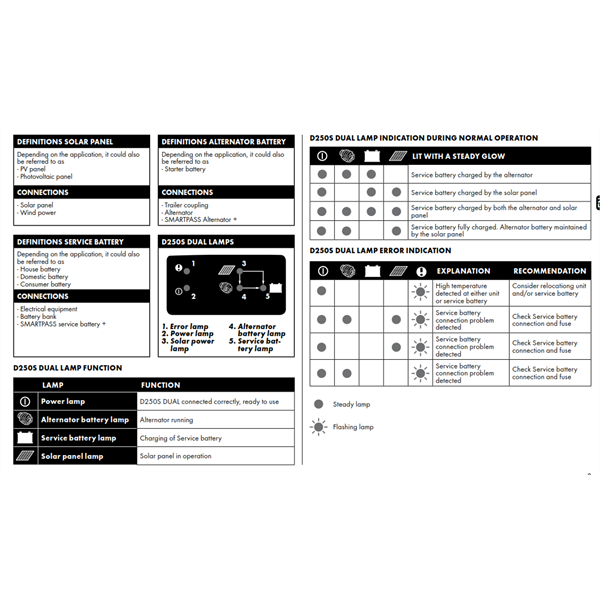
D250S Operation
The table in the top RH corner of this page from the operators manual explains the situation. You will note that the bottom line shows the "Service battery lamp" is extinguished when the battery comes up to charge.
FollowupID:
777233
Follow Up By: Member - John and Val - Saturday, Dec 29, 2012 at 07:04
Saturday, Dec 29, 2012 at 07:04
Shane,
Bill and Peter are right. The "problem" you have is that the battery is fully charged (!) and the 250S has recognised this and gone into float (charge maintenance) mode. It takes the charger 10 minutes or more to decide that the battery really fully charged, hence the delay you have observed.
When the battery does require charge, the charger should deliver about 14.2 to 14.4 volts, whether derived from the alternator or from the solar panels. The panel voltage under these conditions should be about 17 to 18.
All sounds good to me!
Cheers
John
| J and V
"Not everything that can be counted counts, and not everything that counts can be counted."
- Albert Einstein
Lifetime Member
My Profile My Blog Send Message |
FollowupID:
777236
Follow Up By: scandal - Saturday, Dec 29, 2012 at 09:43
Saturday, Dec 29, 2012 at 09:43
Thanks for that, now it makes perfect sense.
Shane
FollowupID:
777243
Reply By: Tim Owen - Saturday, Dec 29, 2012 at 08:54
Saturday, Dec 29, 2012 at 08:54
I also own one of these chargers and agree what you are observing is perfectly normal
AnswerID:
501199
Follow Up By: scandal - Saturday, Dec 29, 2012 at 11:38
Saturday, Dec 29, 2012 at 11:38
Thanks Tim,
FollowupID:
777249
Reply By: KenInPerth - Saturday, Dec 29, 2012 at 16:24
Saturday, Dec 29, 2012 at 16:24
Hi all
I have one of these and did some testing on the solar input for those interested.
The Altermator input to the unit as per the owners booklet cuts in around 13.1V.
However the Solar input will cut in around 12V even though after contacting Ctek themselves (and as John said in his reply) they claim 17 to 18V is suggested, but I am not sure if that is because that can be the general output voltage of solar cells in good operating conditions and providing enough current to be time efficient for charging.
I found the low cut in on the Solar input handy because you can use any source capable of 12V or better (and some reasonable amps) to charge batteries as a secondary source eg. wind generator
I also found that using a smart charger connected directly to the batteries without disconnecting the Ctek did not seem to work too
well as it "confused" the smart charger - although Ctek do have their own charger they show as being able to directly connect to the batteries with the 250S Dual in place.
For the many that know a lot more than myself, it would seem though that to attain the maximum charge current when required (20A) via the solar input would require some 240Watt of panels, but I am guessing if less current is available it will just take longer to charge the batteries ?? And it would be argued I guess that the solar input is for maintenance of the batteries more than regular charging.
My batteries generally take the full 20A from the alternator on startup even after a day of low use (2 x 120W AGM running a 40l Evakool on minimum setting and economy mode for a day - just to keep the beer cold of course).
AnswerID:
501214