Group Captain Clive Robertson Caldwell DSO, DFC & Bar (28 July 1910 – 5 August 1994) was the leading Australian air ace of World War II. He is officially credited with shooting down 28.5 enemy aircraft in over 300 operational sorties. In addition to his official score, he has been ascribed six probables and 15 damaged. Caldwell flew Curtiss P-40 Tomahawks and Kittyhawks in the North African Campaign and Supermarine Spitfires in the South West Pacific Theatre. He was the highest-scoring P-40 pilot from any air force and the highest-scoring Allied pilot in North Africa. Caldwell also commanded a Royal Air Force (RAF) squadron and two different Royal Australian Air Force (RAAF) wings
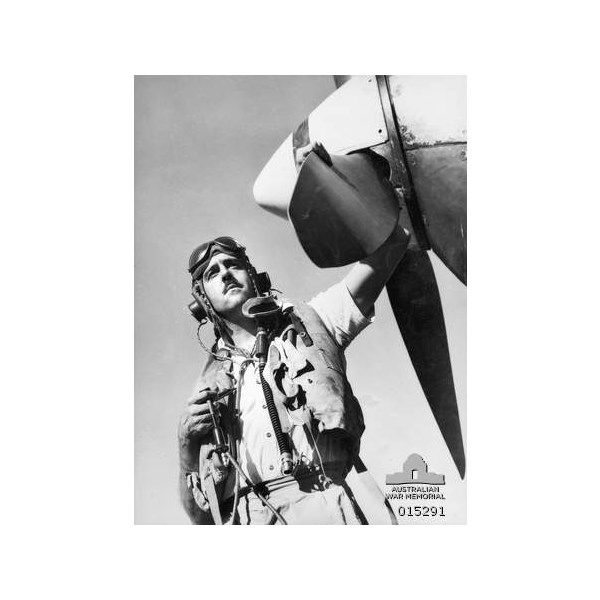
Clive Robertson Caldwell
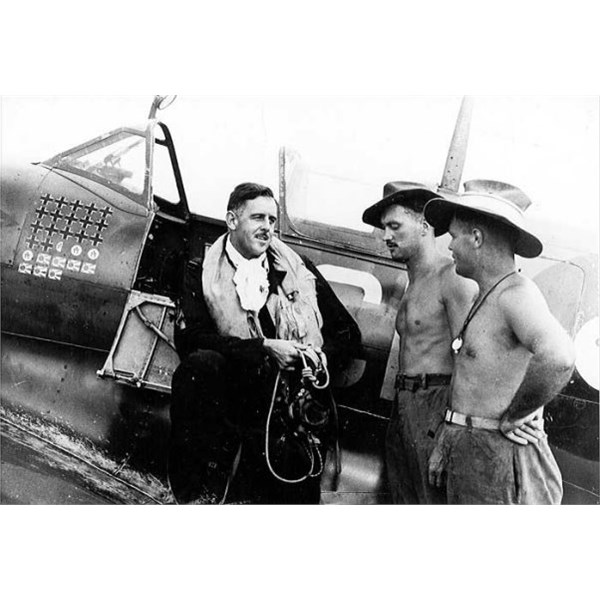
Clive Caldwell chatting with Aussies
He was born in Lewisham,
Sydney and educated at Albion
Park School,
Sydney Grammar School and Trinity Grammar School. He learned to fly in 1938 with the Aero Club of New South Wales. When World War II broke out, he joined the Royal Australian Air Force (RAAF), with the intention of becoming a fighter pilot. As he was over the age limit for fighter training, Caldwell persuaded a pharmacist friend to alter the details on his birth certificate. He was accepted by the RAAF and joined the Empire Air Training Scheme (EATS; also known as the British Commonwealth Air Training Plan and similar names).
Caldwell's first, brief combat posting was a British Hurricane unit, No. 73 Squadron, Royal Air Force, in the early stages of the North African campaign. He had gained only a few operational hours when he was transferred to No. 250 Squadron RAF as it converted to the new P-40 Tomahawk, one of the first units in the world to operate P-40s. According to some accounts. Caldwell was involved in the P-40's first ever kill, of an Italian CANT Z.1007 bomber, over Egypt on 6 June 1941. However, the claim was not officially recognised. (Hamlyn and Sergeant Tom Paxton scored the first official kill two days later.
After he struggled to acquire the skill of gunnery deflection, Caldwell developed a training technique, known as "shadow shooting", in which he fired at the shadow of his own aircraft on
the desert surface. This was later widely adopted by
the Desert Air Force
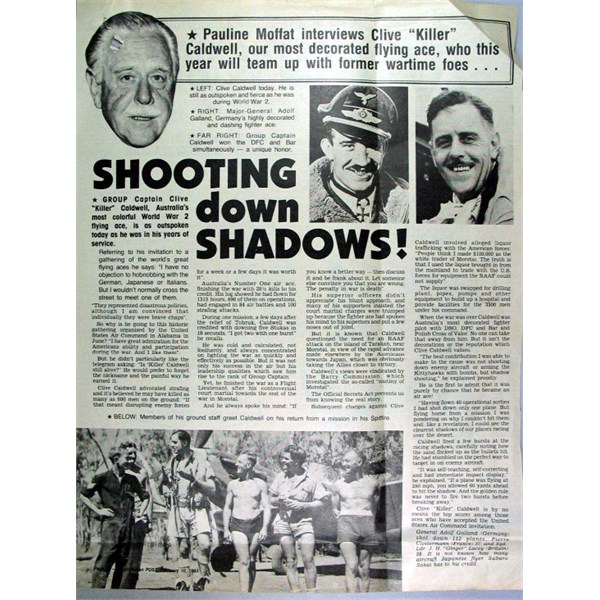
Newspaper Clipping
While flying to his base alone, over north west Egypt on 29 August 1941, Caldwell was attacked by two Bf 109s, in a deadly simultaneous approach at right angles. His attackers included one of Germany's most famous Experte (aces), Leutnant Werner Schroer of Jagdgeschwader 27 (JG 27), in a Bf 109E-7. Caldwell sustained three separate wounds from ammunition fragments and/or shrapnel; his Tomahawk was hit by more than 100 7.9 mm bullets and five 20 mm cannon shells, but he shot down Schroer's wingman, and heavily damaged Schroer's "Black 8", causing Schroer to disengage. On 23 November, Caldwell shot down an Experte, Hauptmann Wolfgang Lippert, gruppenkommandeur of II./JG 27, who bailed out. Lippert had struck the tailplane and following capture had his legs amputated but ten days later a gangrene infection set in and he died on 3 December. For this action Caldwell was awarded the Distinguished Flying Cross.Caldwell claimed five Junkers Ju 87 (Stuka) dive bombers in a matter of minutes on 5 December. For this he was awarded a Bar to his DFC.His report of that action reads.
(I received radio warning that a large enemy formation was approaching from the North-West. No. 250 Squadron went into line astern behind me and as No. 112 Squadron engaged the escorting enemy fighters we attacked the JUs from the rear quarter. At 300 yards I opened fire with all my guns at the leader of one of the rear sections of three, allowing too little deflection, and hit No. 2 and No. 3, one of which burst into flames immediately, the other going down smoking and went into flames after losing about 1000 feet. I then attacked the leader of the rear section...from below and behind, opening fire with all guns at very close range. The enemy aircraft turned over and dived steeply... opened fire [at another Ju 87] again at close range, the enemy caught fire...and crashed in flames. I was able to pull up under the belly of one of the rear, holding the burst until very close range. The enemy... caught fire and dived into the ground.)
The citations for both the original DFC and the Bar were published in the same issue of the London Gazette, a supplement to that of 23 December 1944, dated 26 December 1944. The first citation described Caldwell as continuing to "take his toll of enemy aircraft" and that "he personally shot down 5 of the enemy's aircraft bringing his total victories to 12." The second that he "has performed splendid work in the Middle East operations", "shown dogged determination and high devotion to duty which have proved an inspiration to his fellow pilots", and that after receiving "wounds on his face, arms and legs...he courageously returned to the attack and shot down one of the hostile aircraft."
When Caldwell left the theatre later that year, the commander of air operations in North Africa and the Middle East, Air Vice Marshal Arthur Tedder described him as: "an excellent leader and a first class shot". Caldwell claimed 22 victories while in North Africa flying P-40s, including ten Bf 109s and two Macchi C.202s. He had flown some 550 hours in over 300 operational sorties.
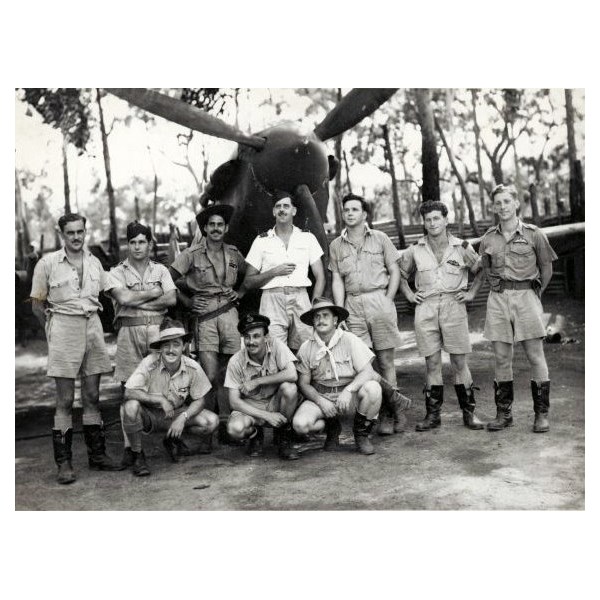
W-Cdr Clive Caldwell (middle) pilots of No. 1 Fighter Wing RAAF near Darwin, 1943
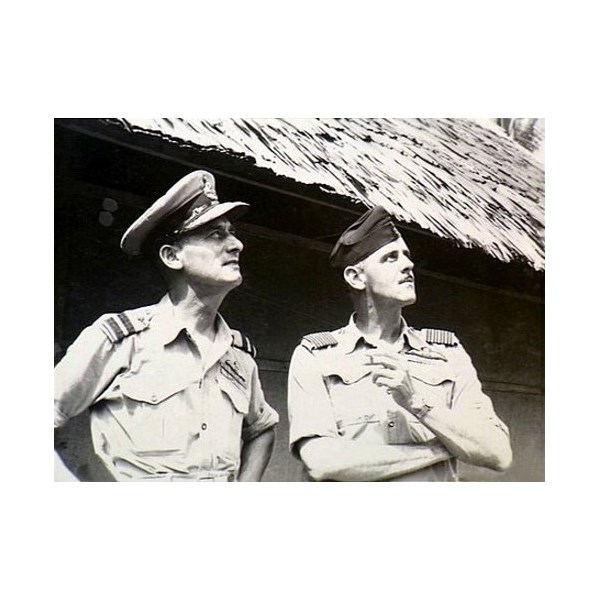
Air Commodore Cobby (left) and Group Captain Caldwell (right), 1945
Australia came under increasing pressure from Japanese forces, and Caldwell was recalled by the RAAF, to serve as the wing leader of No. 1 (Fighter) Wing, comprising No. 54 Squadron RAF, No. 452 Squadron RAAF and No. 457 Squadron RAAF. The wing was equipped with the Supermarine Spitfire and in early 1943 was posted to
Darwin, to defend it against Japanese air raids.
Caldwell claimed two kills in his first interception sortie over
Darwin, a Mitsubishi A6M Zero (also known by the Allied codename "Zeke") fighter and a Nakajima B5N "Kate" light bomber. The Spitfire pilots found Japanese fighter pilots reluctant to engage Allied fighters over Australia, due to the distance from their bases in the Dutch East Indies. The wing initially suffered high losses, due to the inexperience of many of its pilots, and teething mechanical problems with their newly-"tropicalised" Mark VC Spitfires. This was viewed with concern by high commanders, to such extent that the Allied air commander in the South West Pacific, Major General George Kenney, considered sending the wing to the New Guinea campaign, and returning U.S. Fifth Air Force fighter units to
Darwin.
Caldwell scored what was to be his last aerial victory, a Mitsubishi Ki-46 "Dinah" of the 202nd Sentai, over the Arafura Sea on 17 August 1943. He claimed a total of 6.5 Japanese aircraft shot down.
Later in 1943, Caldwell was posted to
Mildura, to command No. 2 Operational Training Unit (2OTU). He was awarded the Distinguished Service Order (DSO) in November 1943. By 1944, with the Japanese forces retreating north, Caldwell was again posted to
Darwin, this time commanding No. 80 (Fighter) Wing, equipped with the Spitfire Mark VIII.
In April 1945, while serving at Morotai in the Dutch East Indies with the Australian First Tactical Air Force, as Officer Commanding No. 80 Wing, Caldwell played a leading part in the "Morotai Mutiny", in which several senior flyers resigned in protest at what they saw as the relegation of RAAF fighter squadrons to dangerous and strategically worthless ground attack missions. An investigation resulted in three senior officers being relieved of their commands, with Caldwell and the other "mutineers" cleared.
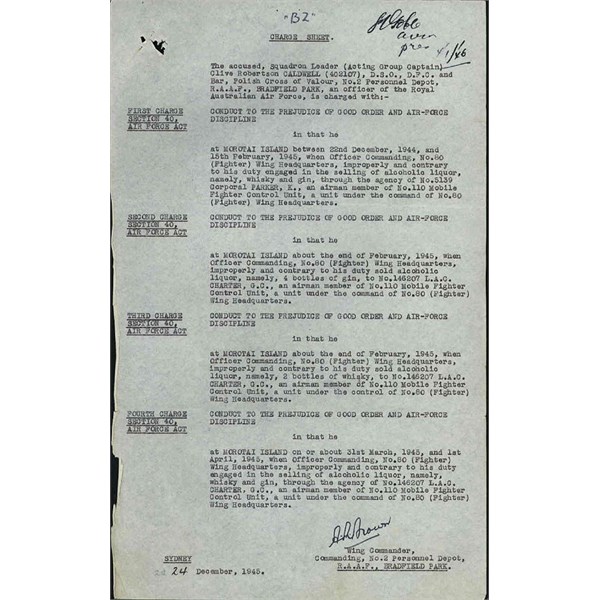
The Charge Sheet
Prior to the "mutiny", Caldwell had been charged over his involvement in an alcohol racket on Morotai, where liquor was flown in by RAAF aircraft and then sold to the sizable U.S. forces contingent in the locality. He was court martialled in January 1946 and reduced to the rank of Flight Lieutenant. Caldwell left the service in February.
After the war, Caldwell was involved as a purchasing agent obtaining surplus aircraft and other military equipment from the U.S. Foreign Liquidation Commission in the Philippines. The aircraft and equipment were exported to Australia in 1946. After the successful conclusion of this venture, Caldwell joined a cloth import/export company in
Sydney and shortly after became its managing director. He became a partner in 1953 and later served as chairman of the board. The firm, Clive Caldwell (Sales) Pty Ltd, achieved considerable success under Caldwell's direction and expanded through subsidiaries worldwide.
Although in later life Caldwell "spoke modestly" about his wartime service, upon his death in
Sydney on 5 August 1994, Australians "mourned the passing of a true national hero.
Distinguished Service Order (DSO) - awarded 14 October 1943.
Distinguished Flying Cross and Bar (DFC*) - both awarded 26 December 1941
1939-1945 Star - campaign medal
Air Crew Europe Star - campaign medal
Africa Star with "North Africa 1942-43" Clasp - campaign medal
Pacific Star
Defence Medal
War Medal 1939–1945 - campaign medal
Australia Service Medal 1939-45 - campaign medal
Polish Cross of Valour - permission to wear granted 2 August 1942.
.